- 24/7 sports gambling apps legal
- 24/7 iCasino apps not legal
- No addiction or bankruptcy prevention protections
- Operators can offer bets to individuals demonstrating addictive gambling behaviors
- Unusually low tax rate for online gambling.
- Joined the bipartisan 38-state Attorney General coalition opposing Kalshi-style sports-event contracts (April 2026).
- Some low-impact consumer policies in place.

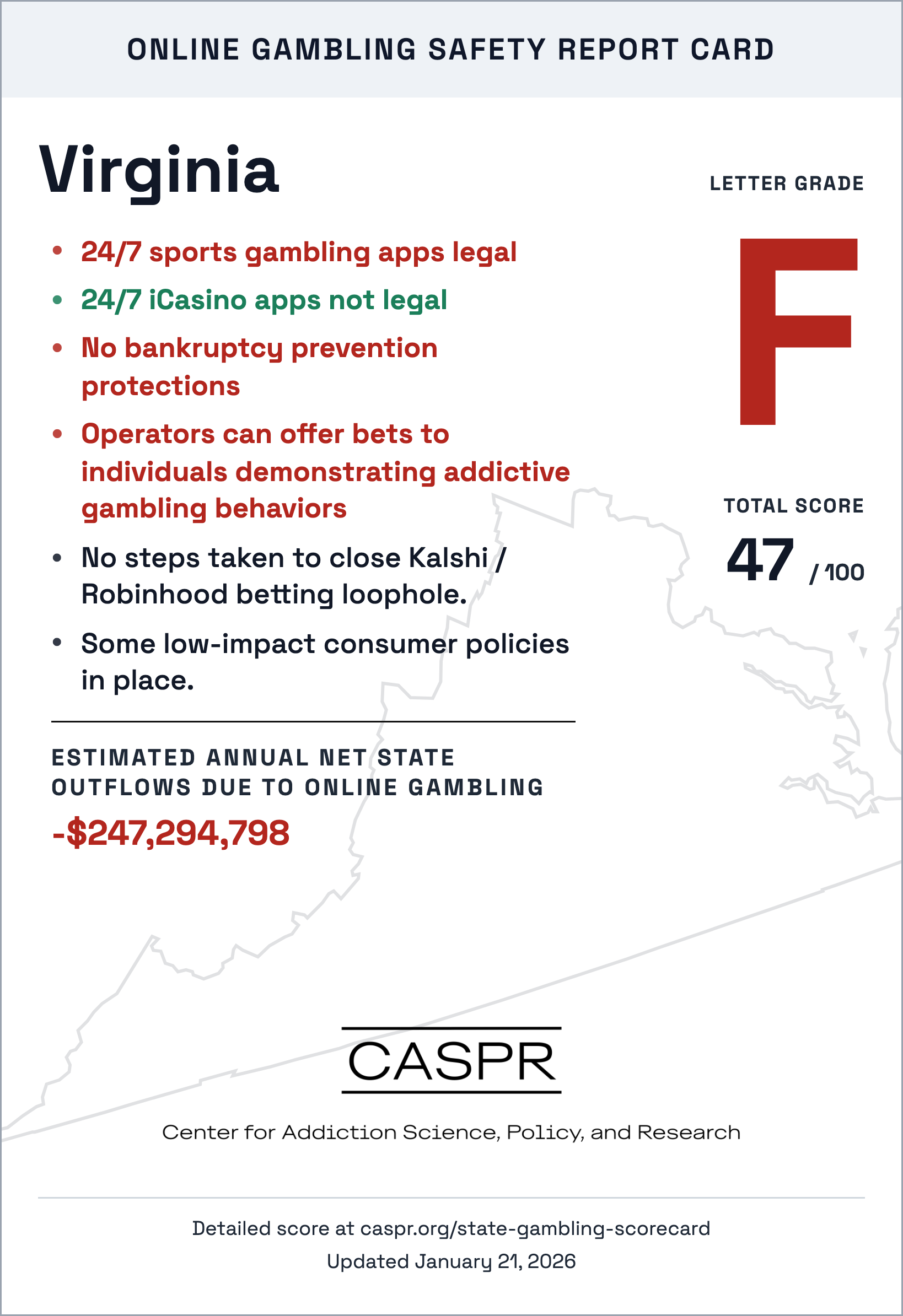
Virginia VA
Score: 51 / 100
Report Card
Legal Status
| Legal Status | Notes & sources | |
|---|---|---|
| Online sports betting | Legal |
|
| iCasino (online casino-style games) | Not legal |
|
| Minimum age (sports betting) | 21+ |
|
Estimated Net Outflows
Online gambling apps route losses to out-of-state operators and vendors, creating large net leakages from state economies and reduced in-state spending by residents, even after deducting retained state taxes and activity from in-state app operations.
Model: gambling-flows (mid scenario, 2025; source data 2026-05-29).
History and Overview
- When betting apps were legalized/launched (sports betting): online + retail launch: January 21, 2021.
- Main legal model / provisions (sports betting): A fairly comprehensive Virginia sports betting bill was signed into law in April 2020. Online sports betting launched in the state in the first weeks of 2021.
- Online casino / iCasino: Not legal.
- Score-relevant protections observed here: Problem gambling hotline (+2), Funding for problem gambling messaging (+2), Non-integrated Self-exclusion list (+2), Close the Kalshi “investment contract” loophole (+2)
Legislative changes since launch
- April 28, 2021 — Reported: Unibet launches in Virginia after receiving approval for an online sports betting license on April 21, 2021.
- March 25, 2021 — Reported: Virginia Governor Ralph Northam signs Senate Bill 1254 and House Bill 1847 , which will officially take effect on July 1, 2021.
- States With Legal Sports Betting - US Legal Sports Betting Timeline . Accessed 2026-05-29.
- US Online Casino Sites & Legal Updates January 2026 . Accessed 2026-05-29.
- Virginia Sports Betting Apps – Top VA Sportsbooks & Betting Promos 2026 . Accessed 2026-05-29.
Score math
Safety Scoring
Scoring methodology and formula.
Online sports betting
Online sports betting apps are legal.
- State Gaming Map . Accessed 2026-05-29.
iCasino (online casino-style games)
iCasino apps are not legal.
- State Gaming Map . Accessed 2026-05-29.
Neither online sports betting nor iCasino
Bonus not awarded — at least one form of online gambling is legal in this state.
- State Gaming Map . Accessed 2026-05-29.
State promotion / advertising of online gambling
Not in place.
Tax Score
Statutory tax rate (sports betting operators): 15%
- Licensed operators are charged 15 percent on all sports betting revenue in Virginia. Most states fall in the six percent to 20 percent range, so this is considered a reasonable tax rate. Virginia’s tax rate is slightly higher than New Jersey’s (13.5 percent) but far lower than Pennsylvania’s (36 percent).
- Code of Virginia Code - Chapter 40. Virginia Lottery Law; Sports Betting . Accessed 2026-05-29.
- Virginia Sports Betting Apps – Top VA Sportsbooks & Betting Promos 2026 . Accessed 2026-05-29.
Age Requirement
0 points for 18+, 2 points for 21+, 5 points for 25+.
- State Gaming Map . Accessed 2026-05-29.
Credit card funding ban
Bans using credit cards to fund online betting.
Problem gambling hotline
Publicly advertised problem-gambling hotline/helpline (and referral to support resources). This is a low-efficacy intervention.
- About the National Problem Gambling Helpline™ . Accessed 2026-05-29.
- Virginia Problem Gambling Resources | National Council on Problem Gambling . Accessed 2026-05-29.
- VACPG . Accessed 2026-05-29.
- Virginia - NAADGS . Accessed 2026-05-29.
Funding for problem gambling messaging
Earmarks funds for problem gambling education/public-awareness messaging (not just voluntary operator messaging). This is typically small and often poorly executed.
- [Archived] 2023 Budget Update: Publicly Funded Problem Gambling Services in the United States . Accessed 2026-05-29.
- 2023 Budget Update: Publicly Funded Problem Gambling Services in the United States (PDF) . Accessed 2026-05-29.
- VACPG . Accessed 2026-05-29.
- Virginia Problem Gambling Resources | National Council on Problem Gambling . Accessed 2026-05-29.
- Virginia - NAADGS . Accessed 2026-05-29.
Non-integrated Self-exclusion list
State provides a self-exclusion program (ideally centralized across licensed operators). This is a low-efficacy tool when not integrated into the gambling user flow.
- Voluntary Exclusion Program . Accessed 2026-05-29.
Mandatory loss limits
Mandatory, enforceable, cross-operator loss limits that cap how much a person can lose in a time period (e.g., monthly). Highly effective for preventing bankruptcies.
Inducement / promo restrictions
Bans or tightly limits promotional inducements (bonuses, risk-free bets, boosted odds) used to accelerate losses.
Ban on in-game betting and microbets
Prohibits in-game/live betting so wagers can only be placed before events begin.
Mandatory operator intervention / duty of care
Requires operators to stop offering bets when users exhibit defined high-risk patterns (not merely provide links to a hotline).
Spousal consent for joint accounts
Requires explicit spousal consent before connecting or using a shared/joint bank account for gambling.
Default deposit/loss limits at signup
Requires players to set limits at signup (or imposes defaults) rather than burying optional limit-setting tools.
Deposit-to-bet waiting period
Imposes a mandatory waiting period between deposits and wagering to reduce compulsive 'tilt' behavior.
Strong advertising protections
Imposes meaningful limits on gambling advertising (e.g., time/place bans, tobacco-style warnings) beyond generic 'gamble responsibly' language.
Not allowed in app stores (web only)
Removes gambling apps from app stores, where the easy access and notification systems increase addictive patterns. In states with legal online gambling, these services would remain available on websites.
Public transparency & harm metrics
Requires public reporting on operator harm indicators (e.g., share of revenue from high-risk users, intervention rates), enabling oversight.
Close the Kalshi “investment contract” loophole
State action to block sports event contracts marketed as federally regulated derivatives. Joining the multi-state attorney general coalition (38 AGs as of the April 2026 Massachusetts brief) earns 2 points; cease-and-desist earns 4; court action earns 8 (max 8).
Back to all jurisdictions.